
Can We Keep It Going?
Sustaining progress and ambition after Chicago’s year of historic declines in violence

Author
B. Robert Owens
Civic Committee of the Commercial Club of Chicago
February 2026
When the Civic Committee-formed Public Safety Task Force announced a 10-year goal in 2023, it set an audacious target: to see 75% reductions in shootings and homicides from the recent highs of 2020–2021, when violence spiked nationwide during the COVID-19 pandemic. If realized, these reductions would mean annual shootings below 1,000 and homicides below 200 by 2034 and the lowest per capita violent crime rates in over 60 years.
Figure 1. Civic Committee Public Safety Task Force Violence Reduction Goals
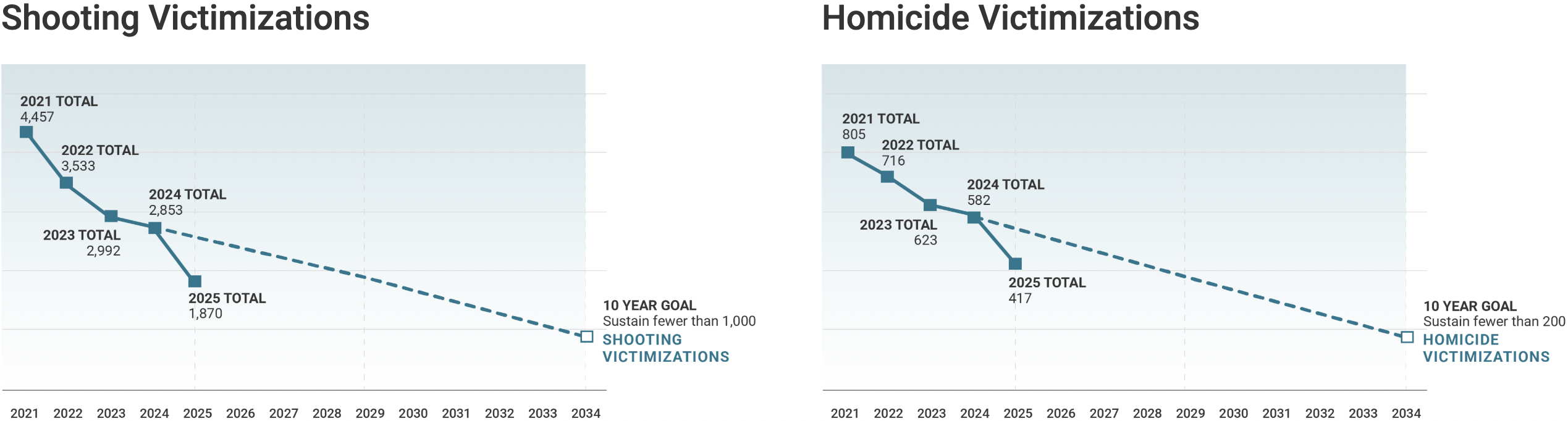
To play its part, the Public Safety Task Force launched a wide-reaching set of investments and programs, ranging from capacity-building in public sector agencies, to investing in Community Violence Intervention, to workforce development in low-employment neighborhoods, to targeted community development investments. Along with partners from government, philanthropy, business, and direct service nonprofits, the task force sought to strengthen the criminal justice system while also addressing upstream, structural drivers of violence. A guiding principle behind the Civic Committee’s public safety efforts is the idea of working around “One Table” where government, direct service nonprofits, business, philanthropy, and community representatives are all contributing in partnership and shared purpose.
Two years into this shared undertaking, 2025 was a year of historic declines in violence for Chicago and the nation. Chicago ended the year with fewer homicide victimizations per capita than in any year since 1965 (15.3 per 100K); the fourth straight year of declines in both shootings and homicides; and the biggest year-to-year drop in both homicide and shooting victimizations over that four-year period (-29.0 percent). Taken together, these outcomes signal remarkable accomplishment and momentum in crime reduction. Neither the Civic Committee nor any of its partners are declaring victory or vindication for their specific strategies. But, of course, all have a shared interest in capitalizing on the recent violence declines.
The urgent question now is, can we keep it going? What happened in 2025 that did so much to reduce violent crime, and can we replicate and extend those conditions in the years ahead? A good place to start is looking at past data on crime declines and what the historical record shows us about how often they are sustained, accelerated, or reversed.
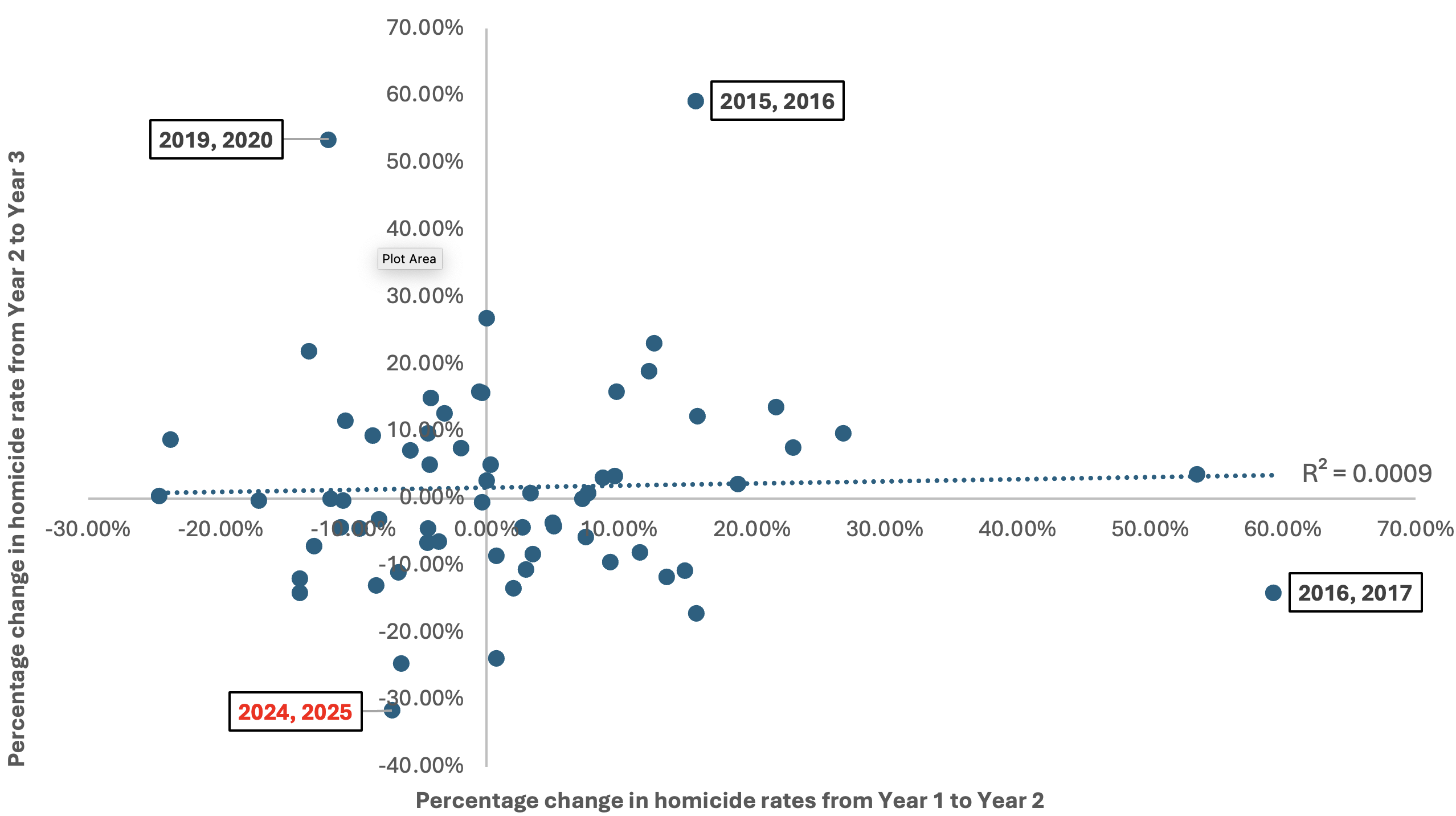
From 1960 to 2025, per capita homicides in Chicago declined almost exactly half the time (33 out of 65 years). Given a one-year decline in homicides, there was a little less than 50 percent chance that homicides would decline in the next year, too. In other words, there was about a one-in-four chance of a two-year streak of declining violence. The longest unbroken streak of falling homicide rates was six years, which Chicago achieved from 1995 to 2000. The second longest is the four-year streak currently active, beginning in 2022. Over the long term, however, Chicago’s norm has been a high degree of randomness in crime level changes from one year to the next. In Chicago, knowing how the homicide rate changed in one year has historically had zero predictive value for the following year. A scatterplot of homicide rate changes in consecutive years in Chicago shows no clear pattern—see Figure 2.
Figure 2. Chicago Homicide Rate Changes in Consecutive Years, 1960–2025
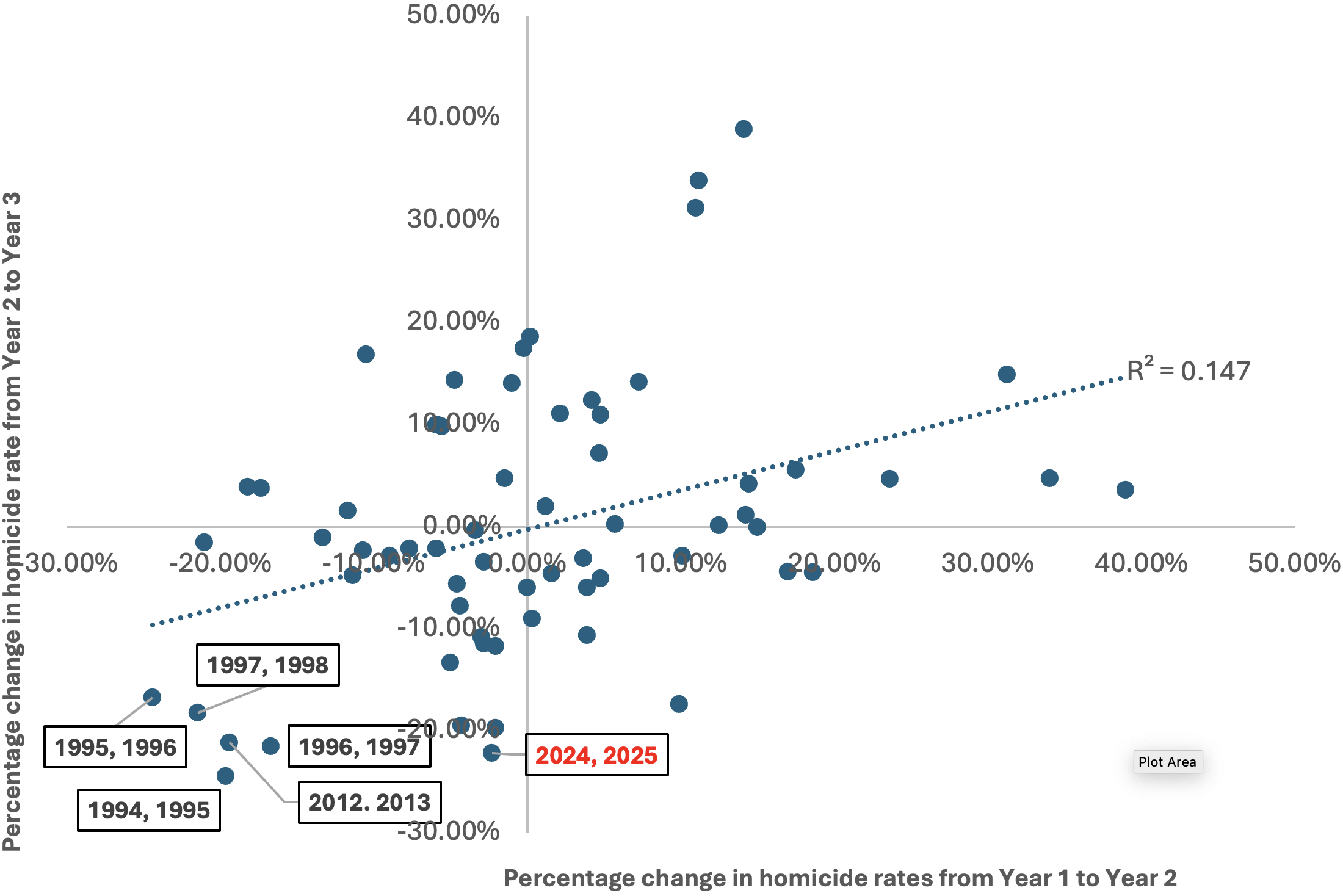
In contrast, New York City has a modest positive correlation in year-to-year results for homicide rate reductions. In New York City, good years were more often followed by good years (and bad years by bad years) Part of what drives New York City’s less-random result is eight successive years of declining homicide rates, from 1991 to 1998, including five successive years of double-digit declines from 1994 to 1998. Figure 3 shows the most consequential years of NYC’s Great Crime Decline labeled in the lower left quadrant.
New York City’s achievement in the 1990s and early 2000s is a model for Chicago today. New York City shows that violence reduction does not have to be a random walk from year to year. Strong crime prevention and response can make the difference. Chicago has benefited from national trends that brought crime down in 2025, just as New York City did in the 1990s. But just as New York City achieved crime reductions that went deeper and lasted longer than the national trend, Chicago can do the same with smart and targeted policies, fully informed by the best available data on what is working.
Figure 3. New York City Homicide Rate Changes in Consecutive Years, 1960–2025
A Steady Target and a Flexible, Data-Informed Strategy
The Civic Committee Public Safety Task Force remains committed to its 10-year goals: to see annual shootings below 1,000 and homicides below 200 by 2034.
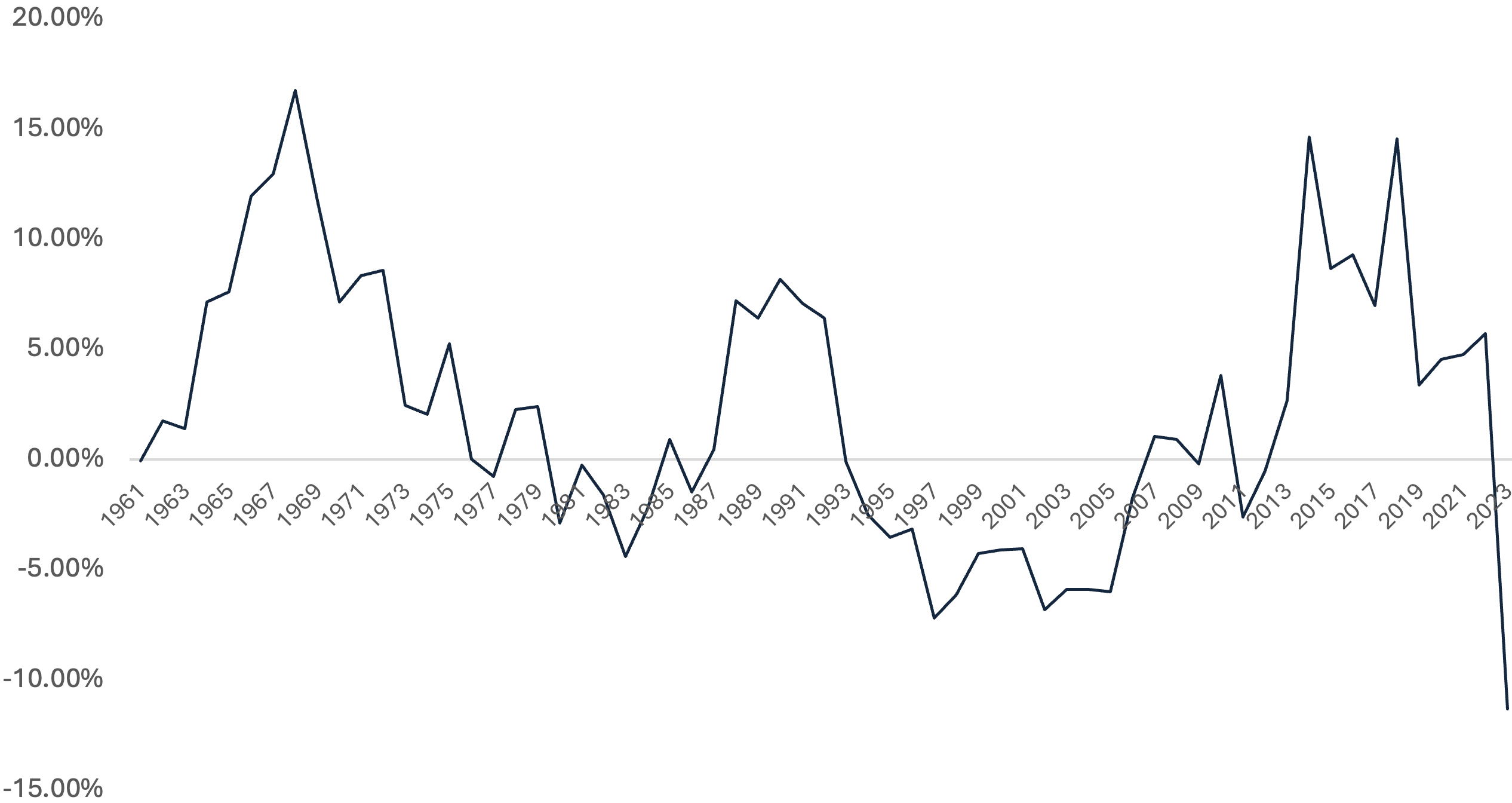
Historical data shows that sustaining violence reductions from one year to the next is by no means certain. Building on reductions to create further reductions is an even more rare achievement. But the same historical data shows it is possible and that we’re on the right trajectory. A look at the rolling average change in homicide rates over several years (Figure 4) shows that Chicago’s progress is not just a one-year phenomenon.
Figure 4. Chicago Rolling Five-Year Average Change in Homicide Rates
Nor is Chicago’s recent violence reduction geographically limited. Every high-violence neighborhood has seen large declines in shootings and homicides. In future posts on this page, we will look in more detail at neighborhood-level data and what we should look for in the years ahead to assess neighborhood-specific violence reductions programs and policing strategies. Historic, permanent reductions in violence remains the North Star goal of the Civic Committee and its many collaborative partners. Quantitative and qualitative data on crime patterns at the neighborhood level, police and prosecutor effectiveness, and measures of neighborhood disadvantage will remain vitally important as we continue to invest in making Chicago the safest big city in America.