
2025 Chicago Crime Statistics Year in Review

Author
John K. Roman
NORC at the University of Chicago
January 2026
Over the last five years, the United States has experienced pronounced volatility in violent crime. Homicide increased sharply at the onset of the COVID-19 pandemic and then entered a sustained decline beginning in 2022, with that decline accelerating through 2024 and 2025. Nationally, homicide rose by 27.5 percent between 2019 and 2020 and by an additional 4.6 percent in 2021, before reversing course. Between 2021 and 2025, the national homicide rate declined every year, culminating in a 19.8 percent drop from 2024 to 2025.
Chicago’s experience closely tracks these national dynamics but with more variation. Figure 1 uses data from the Chicago Public Safety DataHub’s violent crime trends to compare homicide declines in Chicago to its three peer cities (New York, Los Angeles, and Philadelphia). The data show that all four cities have experienced large homicide declines, and Chicago’s homicide downtrend has generally been steeper than its peers, though Chicago’s absolute level of violence remains higher.
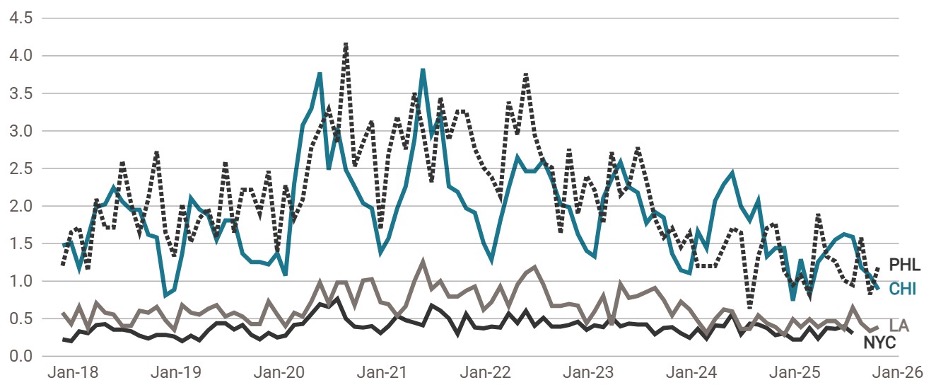
Figure 1. Homicides per 100,000, Chicago, New York City, Los Angeles and Philadelphia, 2018-2025
Figure 2 shows indexed homicide rates for Chicago and the United States. Nationally, homicide increased by 38 percent between 2018 and 2021. In Chicago, homicides increased by 56.2 percent over the same period. The subsequent decline was also steeper in Chicago than it was nationally. After a modest decline of 5.1 percent in 2024, homicides in Chicago fell by 29 percent in 2025.
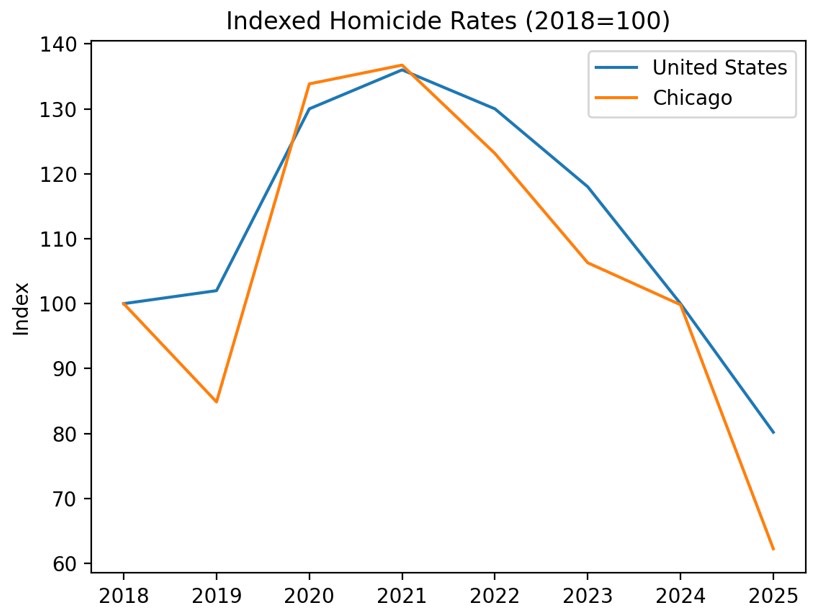
Figure 2. U.S. and Chicago Indexed Homicide Rates, 2018-2025
This decline brought Chicago to a historic low point. In 2025, Chicago recorded fewer homicides than in any year since 1965. This is not a symbolic benchmark: the city has not experienced a lower annual homicide rate per 100,000 since the mid-1960s (Figure 3).
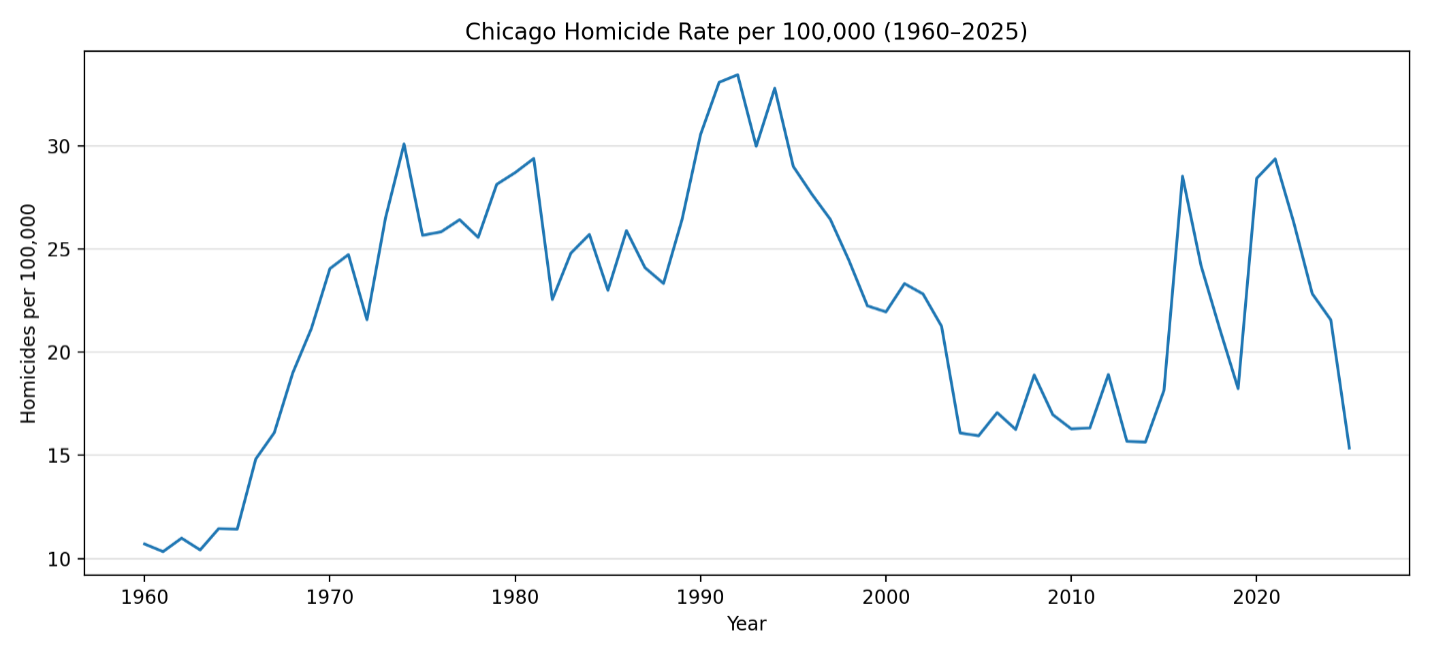
Figure 3. Chicago Homicide Rate per 100,000, 1960-2025
The decline in 2025 was not limited to homicide. Figure 4 shows indexed 12-month rolling totals for homicide, robbery, and aggravated assault in Chicago. Robbery and aggravated assaults serve as proxies for broader measures of gun violence, including robberies with a weapon and assaults with a deadly weapon (there are no national nonfatal shooting data recorded in official statistics, so direct comparisons are difficult). All three offenses increased during the pandemic and declined thereafter, with the steepest declines occurring in 2025. These parallel movements indicate that the improvement was broad-based rather than offense-specific.
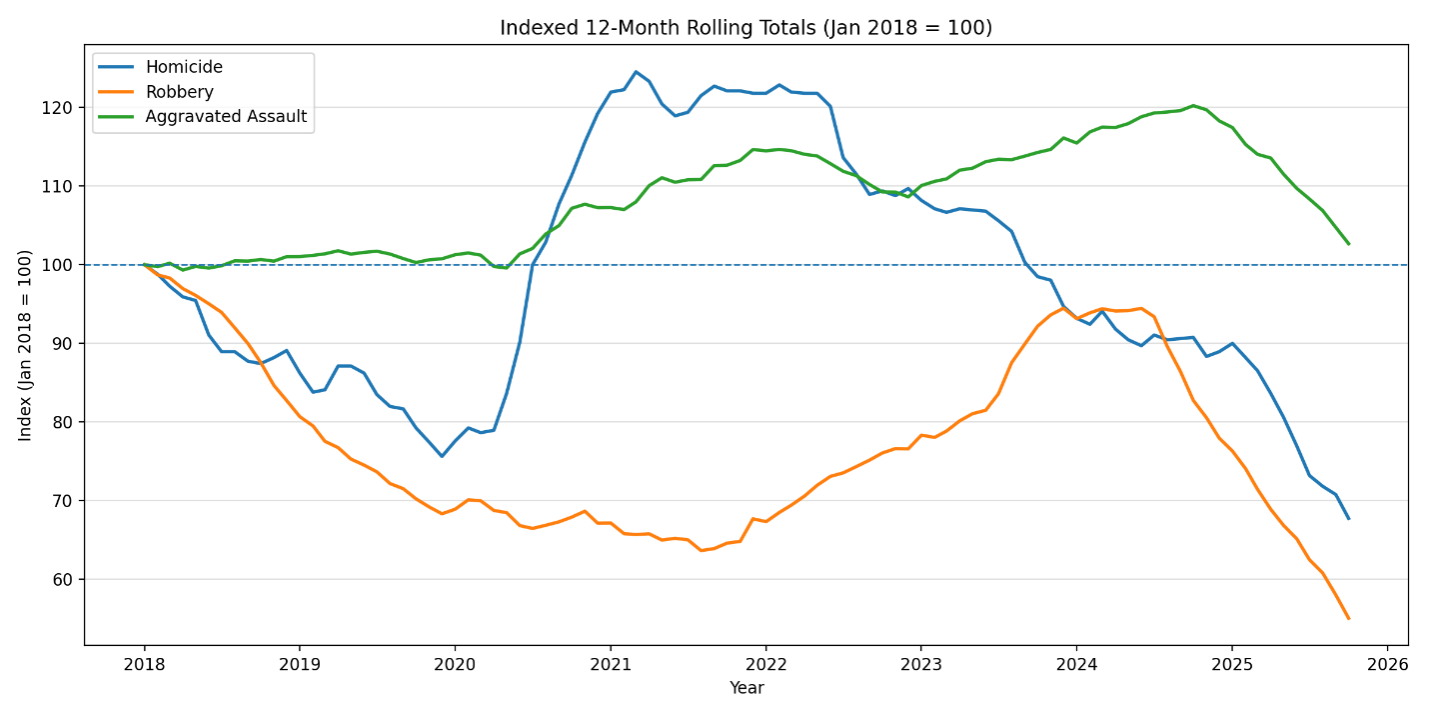
Figure 4. Chicago 2018 Indexed Homicide, Aggravated Assault, and Robbery Rates, 2018-2025
The timing of these changes aligns with national explanations. The initial rise coincided with abrupt disruptions to daily life that made it harder for communities to look out for one another and strained the institutions that help keep neighborhoods safe. As public life resumed and institutional capacity stabilized, homicides declined nationally and locally.
During this period, there were also substantial investments by state and local governments and the business community in community-led anti-violence programs. These Community Violence Intervention (CVI) programs are built on the theory that strengthening community supports and institutional levers will reduce violence. What distinguishes Chicago is not the direction of these changes but their magnitude.
While Chicago’s crime trends remain strongly shaped by national forces, the scale of improvement in 2025 stands out. The city reached its lowest homicide level since 1965 while also recording substantial declines in robbery and aggravated assault. Taken together, the evidence shows that 2025 was not merely a continuation of national trends, but one of the most consequential single-year reductions in serious violence in Chicago’s modern history.
The story of the recent rise and decline in community violence in Chicago is a complex one. Future posts here will explore causes, with an emphasis on innovations like CVI that are potentially replicable and scalable to maintain momentum for declining community violence.